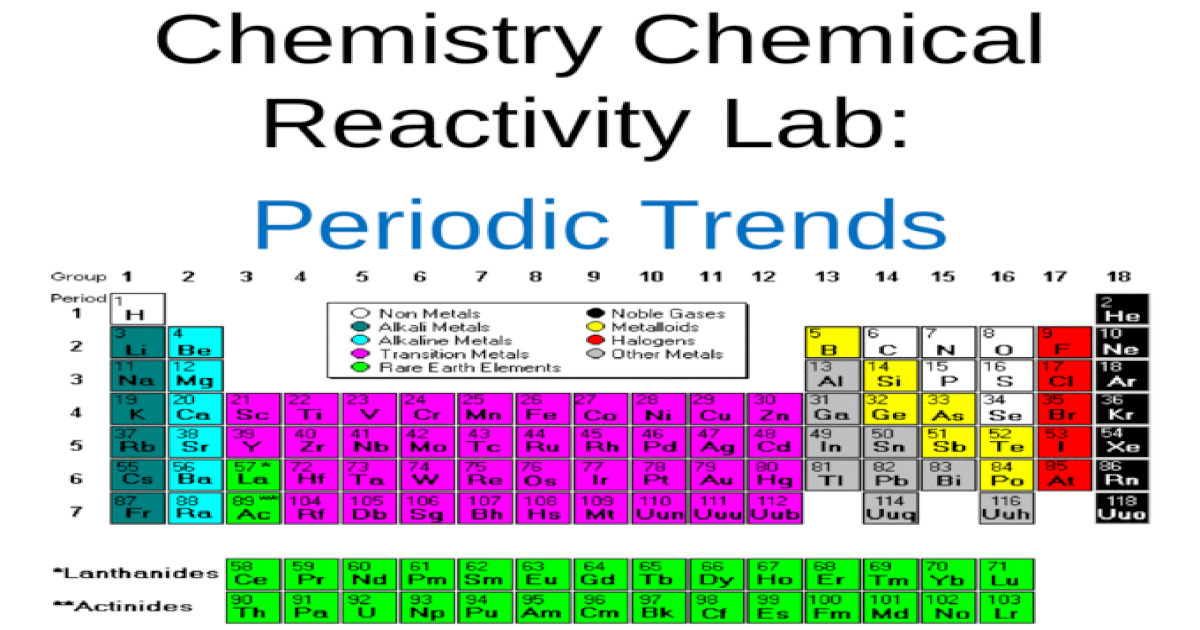
Reactivity Trend On Periodic Table. Reactivity is a measure of how easily an element will combine with other elements to form compounds. For facts, physical properties, chemical properties, structure and atomic properties of the specific element, click on the element symbol in the below periodic table.
Chemistry Chemical Reactivity Lab Periodic Trends [PPT from vdocuments.mx
Nov 172:58 pm reactivity trends metal reactivity increases down a group because as nuclear shielding increases and the nucleus' hold on the valence electron weakens, therefore it is easier to remove valence electrons. Some elements are unreactive and need energy putting in others will react spontaneously and easily. Both highly electropositive and highly electronegative elements have a strong tendency to react.
The Greater Attraction Between The Increased Number Of Protons (Increased Nuclear Charge) And Electrons, Pulls The Electrons Closer Together, Hence The Smaller Size.
Give the students a periodic table. The vertical columns are called groups. As you move from the left side toward the centre of the periodic table, the reactivity (increases/decreases) _^ 4.
Periodic Trends In Reactivity Purpose To Explore The Reactivity Trends Of Metals In Groups And Periods Of The Periodic Table.
As you move down a group in the. Accordingly, what is the periodic trend for non metal reactivity in a group? A chemical that reacts easily with other substances is considered to be highly reactive.
The Horizontal Rows Are Called Periods.
Reactivity of elements of the periodic table. The farther to the left and down the periodic chart you go, the easier it is for electrons to be given or taken away, resulting in higher reactivity. Chemistry the periodic table periodic trends in atomic size 1 answer abdul sammad mar 9, 2016 in metals:
Some Elements Are Unreactive And Need Energy Putting In Others Will React Spontaneously And Easily.
4.) silicon, tin, and lead are all in the same group. They will consolidate using 12 digital task cards. You feel hot in summer and cold in winter.
Just As The Weather Changes During The Entire Year, The Properties Of Elements Also Change Along The Groups And Periods In The Periodic Table.
The most nonmetallic elements are in the top right hand corner of the periodic table. The most nonmetallic elements are in the top right hand corner of the periodic table.metal reactivity increases down a group because as nuclear shielding increases and the nucleus' hold on the valence electron weakens, therefore it is easier to remove valence electrons. Metal reactivity increases down a group because as nuclear shielding increases and the nucleus’ hold on the valence electron weakens, therefore it is easier to remove valence electrons.