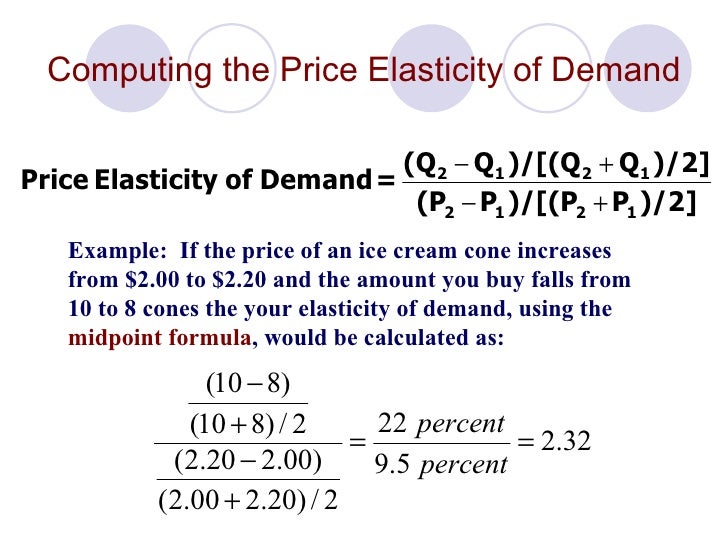
Midpoint Formula Price Elasticity. Why do we always get a different value for a good's elasticity of demand depending on whether the price increases or decreases? Calculating price elasticity of demand.
Elasticity from www.slideshare.net
D) make the coefficient become equal to the slope of the demand curve. Formula for price elasticity of demand. Elasticity in the long run and short.
The Midpoint Elasticity Formula Is A Common Method Of Calculating Elasticity, Especially The Price Elasticity Of Demand, Price Elasticity Of Supply, Income Elasticity Of Demand, And Cross Elasticity Of Demand.
This formula is most often used at the introductory level of economic instruction. The percentage changes are then calculated by subtracting the original and updated values and then dividing the result by their average. We use the midpoint formula in computing the price elasticity of demand coefficient in order to a) make the coefficient value become independent of whether price goes up or down.
More On Total Revenue And Elasticity.
When there is a small change in product price causes a major change in its demand. In the midpoint formula, the price elasticity of demand is calculated by dividing the percentage change in purchase quantity by the percentage change in price. Using the midpoint formula, what is the midpoint price elasticity of demand for gps units between a price of $10 per unit and a price of $30 per unit?
Calculating Price Elasticity Of Demand.
Price elasticity of demand and price elasticity of supply. This is because the formula uses the same base for both cases. As you may notice, this formula is very similar to the midpoint formula that we use to find the income elasticity of demand.
This Formula Is Most Often Used At The Introductory Level Of Economic Instruction.
Choose currency units and enter the following: C) eliminate the negative sign of the coefficient. This indicates a price elasticity of 0.75 (i.e., 25/33).
Let’s Calculate The Elasticity Between Points A And B And Between Points G And H Shown In Figure 1.
Why do we always get a different value for a good's elasticity of demand depending on whether the price increases or decreases? Well, if you're finding this. Elasticity in the long run and short.