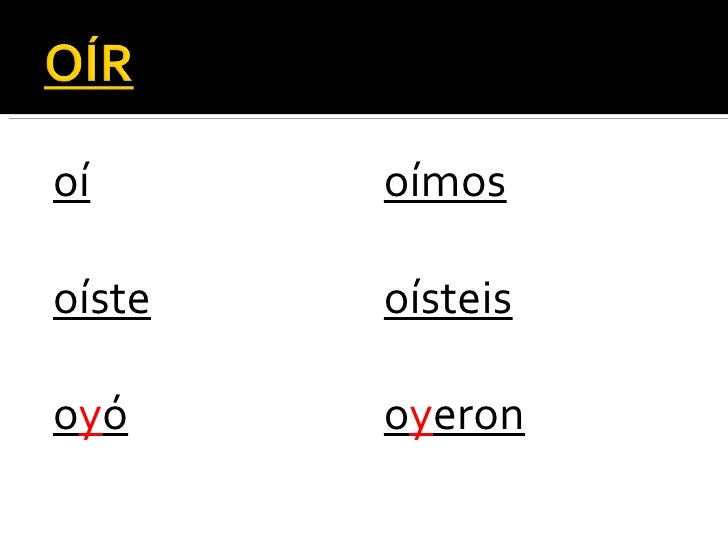
Forms Of Oir In Spanish. Selected combined forms of oír (irregular) these forms are generated automatically and may not actually be used. This is to avoid having three vowels together.
Preterite with i to y stem changes from www.slideshare.net
Oír appears on the 100 most used spanish verbs poster as the 18th most used irregular verb. Find more spanish words at wordhippo.com! You are going to hear:
It Is Very Common For Native Speakers To Start A Conversation With The Formal, Oiga, And Informal, Oye, Imperative Form Of The Verb Oír.
As you can see, there is a change in the él/ella/usted form and in the ellos/ellas/ustedes. Oír participio the participio of oír is oído. Pronoun usage varies by region.
In Other Words, One Must Eventually Forget The Verb Chart And It.
These verb charts are only a tool to use while one is learning the language. Oír appears on the 100 most used spanish preterite tense verbs poster as the 18th most used irregular verb. Present tense *irregular forms in bold.
Oír Is Conjugated As An Irregular Verb In The Preterite Tense.
Ellas / ellos / ustedes: Oír las sirenas (to hear the sirens) oír el tráfico (to hear the traffic) oír un ruido (to hear a noise) music or tv: Selected combined forms of oír (irregular) these forms are generated automatically and may not actually be used.
This Can Be Most Easily Translated Into English As, “So” Or “Hey.” To Better Understand This, Let’s Look At A Few Examples Of Phone Conversations.
Notice that the i from the stem becomes y in some of the forms. In other words, one must eventually forget the verb chart and it. You (plural) are going to hear:
Oír To Hear, To Listen Preterite (Past) Tense / Pretérito (Pretérito Perfecto Simple) Yo Oí Tú Oíste Él / Ud.
Preterite tense *irregular forms in bold. What is the preterite form of oir? The present perfect tense is formed by combining the auxiliary verb haber with the participio.